
TASK: To provide a personal perspective of the ‘mirror or window analogy’ and more generally its usefulness as an evaluative tool in photography. The 500-word essay should explore other metaphors that can provide insight into the drivers behind image-making as well as my own motivations within photography and its role within my aspirations as an image-maker and storyteller.
RESPONSE:
Reflecting on the Mirror Window Metaphor in Photography
Photography has been classified in many ways. Fine art, representational, landscape, portraiture, commercial. These labels, whilst useful, provide no clues as to the motivation and emotional connections between the photographer, subject, and viewer. The concept of an image being sited on a spectrum between a mirror, (an image created within the photographer’s imagination) and representational (an accurate account of the scene), was first described by John Szarkowski (Szarkowski, 1978). Szarkowski’s conceptualisation offered a new dimension by which photography could be examined. Despite its simplicity, the windows/mirror analogy provided a unique perspective through which one could explore the choices made by a photographer. Sarkowski however was not the first to describe the way in which images communicate both directly and indirectly. In his seminal book Camera Lucida (Barthes, 1981) explains that photographs contain both denoted (real) and connoted (implied) information.
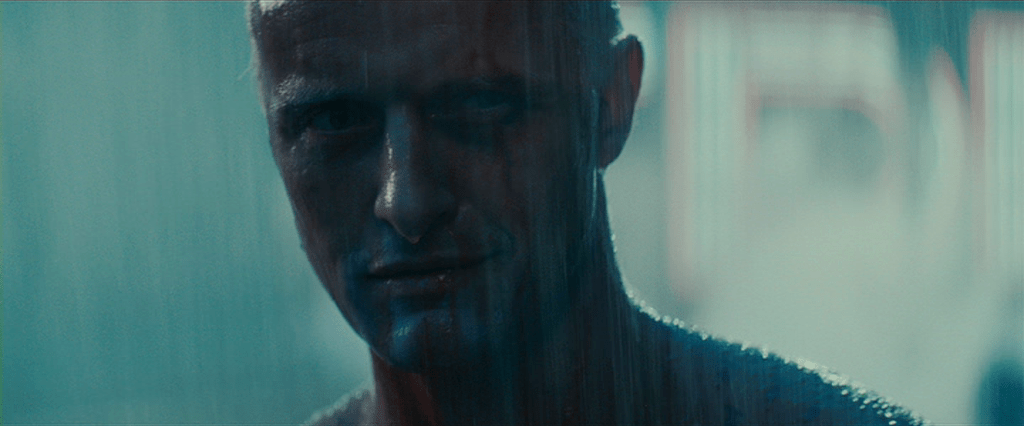
My own journey as an image maker has been one of a gradual transition through the mirror/ window spectrum. My early work was heavily influenced by Cinematographers such as Roger Deakins and Christopher Nolan as well as Film Directors such as David Lean director of Lawrence of Arabia and Ridley Scott Director of the original Blade Runner (figure 1). My photographic inspiration from individuals included Michael Kenna, Don McCullin and Bill Brandt. My early landscape for example my work in Iceland, sits firmly within the fine art genre. It was dark, moody, and devoid of people.
After much soul searching, I concluded my landscape images were influenced by my desire to externalise the challenges of a bipolar and depressive maternal upbringing. Later in my creative journey and having left home and being happily married, I began to explore more cinematic style urban street scenes and modern architecture. Whilst these still contained a degree of self-reflection, they represented my attempts at more accurately representing the mood and drama within the urban environment without the overlay of implied dystopia.
Increasingly, I have been feeling creatively and intellectually restless. I want to focus directly on individuals, the issues that impact them, their emotions, their interactions, their lived experiences at work and play, their struggles and achievements. My sphere of photographic influence has also changed. The work of Mary-Ellen Mark, Bruce Davidson, Chris Killick and Robert Frank now all deeply resonate. Their intentional manipulation of both connoted and denoted visual codes provides their images with searing and deep-rooted messages that engage and challenge the viewer forcing them to confront the issues depicted.
I also recognise that the window/ mirror analogy is by no means the only useful metaphor. For example, one can view a body of documentary photography as acting as a microphone for a disadvantaged group. This is clearly seen in the photojournalism of W.Eugene Smith (Smith and Smith, 1975) who described the gradual poisoning of the local population in Minimata Japan. Without his images, commissioned by Life Magazine, we may never have heard their voices. Similarly, long-form documentary projects can see photography utilised in the same way and have the same influence as the mighty pen. When first published, The Americans by Robert Frank (Frank and Kerouac, 1978) was seen as a searing indictment of the failure of the American dream. The attempts to stifle its publication were similar to those normally associated with the censoring of a written report.
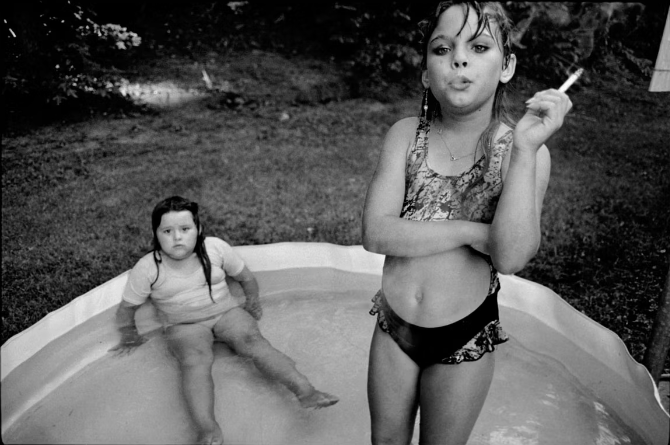
Sometimes photography can feel like a sociological x-ray machine, allowing us to see deeply into the soul of their subjects and vicariously experiencing their lives. The photography of Mary Ellen Mark (figure 2), Bruce Davidson, Don McCullin and Matt Black often exhibit these qualities. Other times this objectivity is purposely ignored. Instead, the photographer is looking to act as judge and jury. Through the selection of their subject matter, choice of the decisive moment, and the underlying rhetoric of their image, the photographer is unashamedly looking to influence the viewer. Whether as seen in the images of death and horror in the Vietnam War by Don McCullin (McCullin, 2020) or man’s destruction of the environment as seen from the air by Edward Burtynsky (Burtynsky et al., 2009) the photographer intends to shock the viewer.
At a personal level, my initial motivations for photography were driven by a desire for concrete evidence of creative skill and mastery of technical expertise. However, whilst being able to achieve aesthetically pleasing work, increasingly I want to create work that is imbued with inherent meaning, reflects issues relating to the human condition and if possible, highlights unseen challenges in our society. I have been fortunate to be born at a time when social mobility was achievable with education and hard work. Whilst I have never looked back, I have also never looked down. I believe I have been somewhat immune to the challenges faced by so many in what is now a form of broken globalised capitalism. If only in a very small way, I am looking for my documentary photography to shed light on some of the injustices in today’s very unequal society.
FIGURES
Figure 1: SCOTT, Ridley. 1982. Blade Runner. FilmGrab [film still]. Available at: https://film-grab.com/?s=blade+runner [accessed 3/10/2023].
Figure 2: MARK, Mary-Ellen 1990. Amanda and her cousin Amy. NPR. [online]. Available at: https://www.npr.org/2015/06/27/417782675/what-happened-to-the-9-year-old-smoking-in-mary-ellen-marks-photo [accessed 3/10/2023]
REFERENCES
BARTHES, R. 1981. Camera lucida: Reflections on photography, Macmillan.
BURTYNSKY, E., MITCHELL, M., REES, W. E., ROTH, P. & SCHUBERT, M. 2009. Edward Burtynsky: Oil, Steidl.
FRANK, R. & KEROUAC, J. 1978. The Americans (1958). Millerton, NY: Aperture.
MCCULLIN, D. 2020. Shaped by War, Random House.
SMITH, W. E. & SMITH, A. M. 1975. MINAMATA: words and photographs. (No Title).
SZARKOWSKI, J. 1978. Mirrors and windows: American photography since 1960.
 The Photography of David Rosen