
Task: What’s your understanding of the word Nature’ how is the term problematic. How does location and place feature in your work? What is the relationship between your practice and human consumption?
My perspective on nature is probably driven by two aspects of my life. The first my age. Being 66 I grew up with little exposure to the terms environmental damage, global warming, and climate catastrophe. Nature was considered by many to be almost limitless in its ability to sustain the output and collateral damage caused by the Industrial Revolution and was considered at some level to be self-healing. The other perspective driving my perception of the term nature was my educational background. Being almost exclusively focused on the three sciences, biology, physics, and chemistry I understood nature as all things organic rather than inorganic. My perceived delineation was unambiguous and absolute.
Half a century on, nature has a far less uncertain identity. It is considered by most, but not all political persuasions as being in danger, a finite resource that humankind has abused and taken for granted. The media displays a constant stream of environmental disasters for which governments promise action but crumble in the face of economic pressures. Dorothea Born in her Source Magazine article Nature Gone Wild describes the types of images used to illustrate these disasters, noting their apocalyptic tone and suggesting why they may lead to inaction. I am mindful of similar assertions have been made regarding the imagery used to educate smokers on the health risks associated with cigarettes.
The fear and some guilt with regards to our consumerist lifestyles and its impact on climate change, however, lies in direct contradiction to the way we view nature as a pleasurable asset for which we can at our choosing enjoy both when and where we choose. We can enjoy bucolic hillsides, and lay idly on perfect faraway beaches, feeling that nature is ours for the taking with little to remind us of its current fragility. We often combine our interactions with nature with our leisure time picking and choosing the location and time of year when we are guaranteed to be met with picturesque landscapes and seascapes. All too often allowing climate change to dissipate temporarily into our subconscious.
With the focus of my previous practice being urban environments and my future focus for the MA studying the impacts of urban poverty and homelessness, my interests are fundamentally the large metropolitan cities. I look to understand the way in which we navigate their built environments, and how inequality impacts the way in which individuals live, interact, and seek security. Traditionally, landscapes have been thought of as pertaining to the countryside and of the sublime and picturesque rendition of places and scenery. However urban environments in particular architecture and street photography now form a burgeoning part of photography’s image output.
Having had an active practice in street photography for a number of years located in central London, a large number of my photographs have been taken within streets populated by retail stores. I recently completed a project on the lifestyles of the individuals frequenting the exclusive stores located in and around Bond Street.
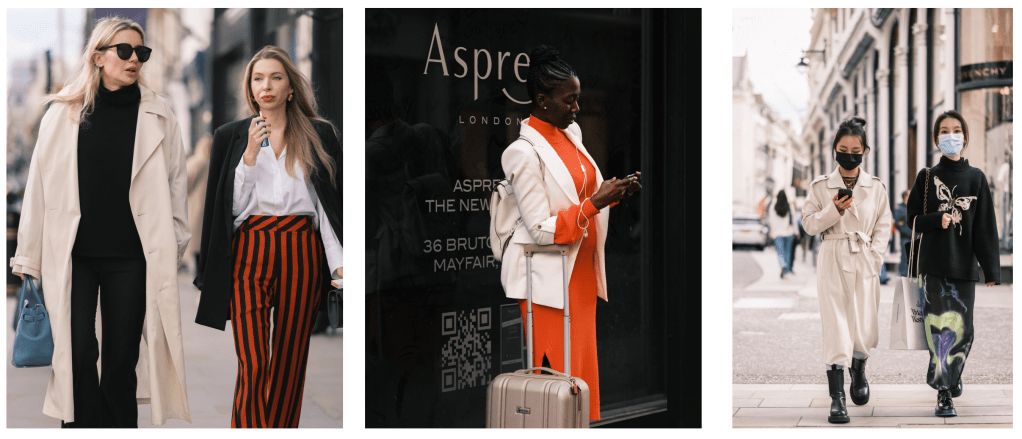
Many of the goods purchased are made abroad in countries such as Italy, known for their high couture with little or no consideration for the impact of transporting these goods to the UK. Meanwhile, items such as diamonds and other precious stones are extracted from mines based in third-world countries at significant environmental and human costs. In photographing such activities in the style associated with fashion magazines, I am likely to be accused of encouraging and glorifying these activities ignoring the environmental dangers they pose.
FIGURES
Figure 1: David Rosen. 2022. Bond Street Shoppers.
 The Photography of David Rosen