
Task: Reconsider the visual / technical / conceptual strategies you use to achieve this intent. Identify any approaches / practices / practitioners that specifically resonated with you? Outline / summarise your independent research. Evaluate the development of your own photographic practice to date. Reflect on the peer / tutor feedback you have received on your current / future practice. What are your action points? Where are you going next?
Four weeks into the term and I have come to the realisation, that what I thought was the meaning of ‘intent’ was in fact only a small part of its wider and more comprehensive meaning for creating meaningful bodies of photographic work. My intent had previously been limited to a denoted goal for content and an aesthetic target. My newly acquired understanding of Stuart’s Hall’s reception theory explained by differences in our cultural exposure has helped me understand how the signifier and signified are related. It is clear to me that total control of meaning within an image is fantasy. I have now finally accepted this.
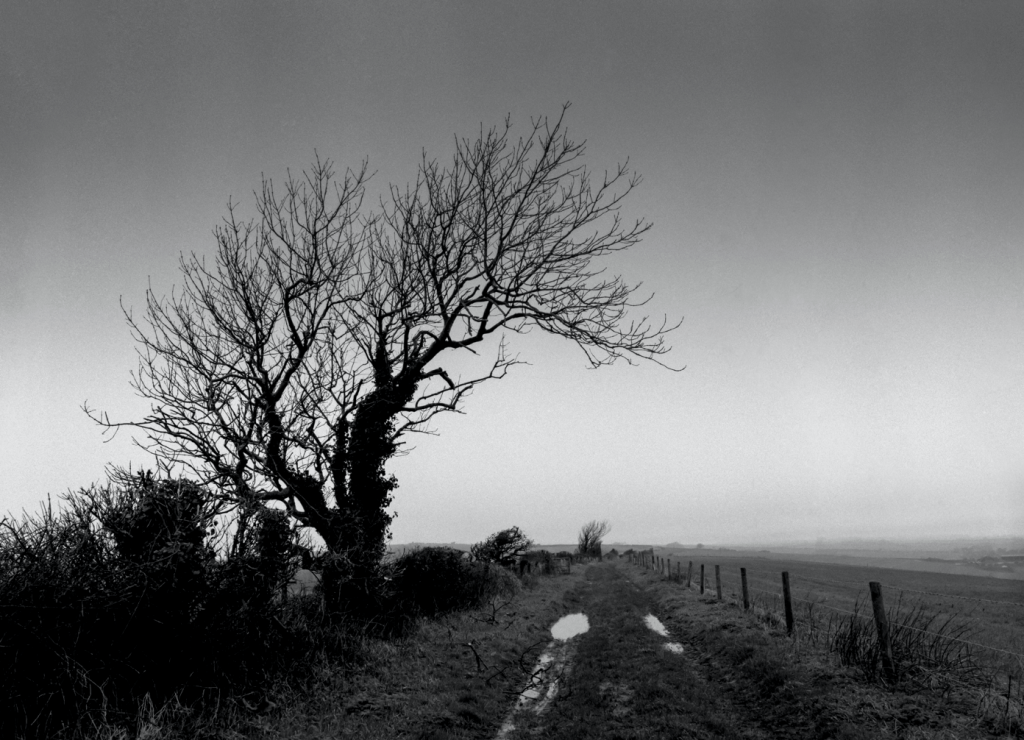
Furthermore, a deeper understanding of semiology including the work of Charles Pierce with regard his explanation of the differences between signs, symbols and indexicality have helped me evaluate my work at a deeper more meaningful level. In defining an intent, I have worked this week to create a series of landscape images to reflect the symptoms of melancholia seen commonly within bipolar disorder. Not only have I been able to draw upon semiology, but also explore intertextuality in its broadest sense. Up to this point, I have seen intertextuality as referring only to how textual descriptions and titles influence images. The realisation that intertextuality refers to any external reference to an image, whether visual, spoken, or textual taken from any part of our cultural memory has opened a world of possibilities for creating narratives. Plays, films, TV, poetry, and music are all open for creative plundering.
Photographic influence from practitioners such as Todd Hiddo with his depiction of liminality and codes taken from cinema with Directors such as David Lynch and Alfred Hitchcock are cited as major influences as well as fine art influences such as Edward Hopper. Meanwhile, Robert Darch, who has created a body of work for his book, The Island employs a sinister and foreboding narrative arising from his view of Post-Brexit Britain and its consequent isolation.
I have also more recently come to realisation, that the accurate representation of scenes within a frame can exclude the photographer from the narrative. Engagement with an image is often amplified when the presence of the photographer can be felt. The concept of dirtying up the frame, whether this be for example by the juxtaposition of an out-of-focus foreground element, or the distortions and lack of fidelity seen with film adds both a sense of mystery and voyeurism as well as almost imperceptibly inviting the photographer into the viewing dynamic.
Finally, my work with Paul, led to a conversation regarding my rather formal perspective of viewing my output ambitions as a gallery space rather than looking to ‘subvert the process’ or choosing a less conventional route for dissemination of my work. Although I understand Paul’s perspective and see it as a valid option, my motivations for gallery exposure and photo book output remain strong. That being said, I will review the references forwarded by Paul and others to understand the various influences of gallery space viewership on my intended body of work.
LIST OF FIGURES
Fig 1: David Rosen. 2023. Naked
 The Photography of David Rosen