
Task: How do you ‘transform’ the world? How might your work be (or not be) considered as a ‘message’? How does context influence how people view your work? How do aesthetics influence the way people view your work? Did any ideas particularly interest you? What challenged you? Have your ideas changed? In your independent research, reflect on your practice in the context of specific visual practices and theoretical points.
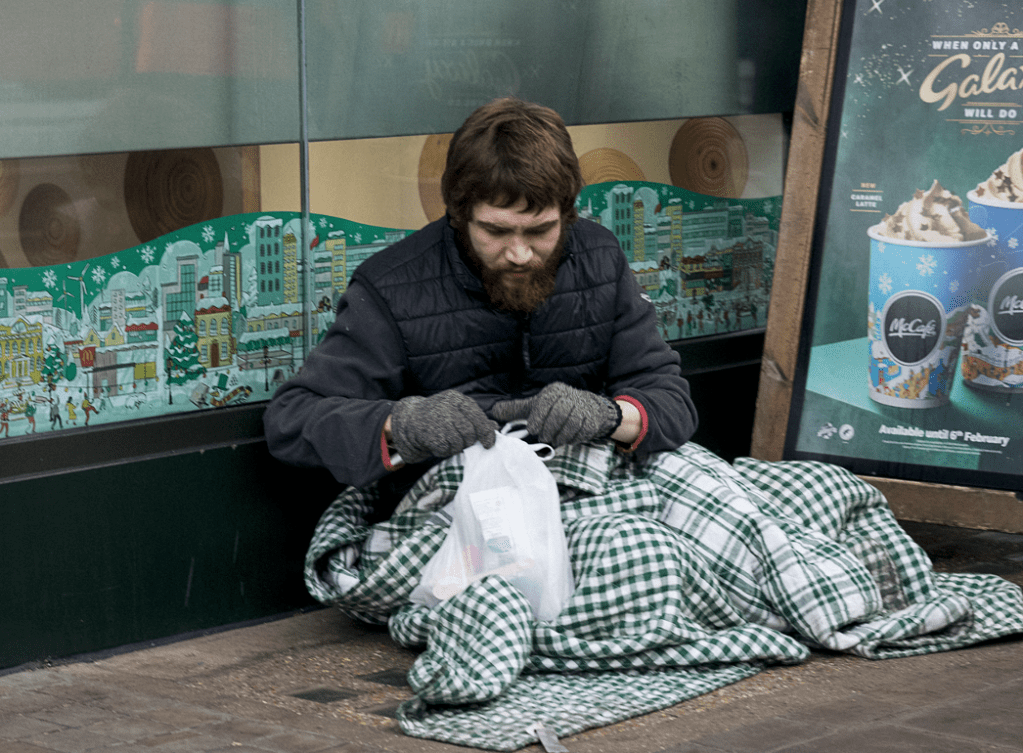
This week we looked at images that are used to project powerful messages, intended to influence us to act or at least exert political pressure with regards an issue. It is rare I believe for an image to transform the world, although, there are a very few examples of images that have achieved this. For example the napaalm girl in Vietnam, or the young migrant boy washed up on the beach in Greece. Such was the anger, guilt and shock that when viewed, these images influenced many people to express outrage, to demonstrate and or initiate a call to action.
At a lower level of impact, advertising images are designed to acheive a similar objective, although in most cases the intention is not to shcok, but to create a desire built around insecurity. This in turn encourages the viewer to purchase a previously unconsidered or partially considered item (Berger 2008). In my first assignment, I attempted to highlight the plight of the homeless, by capturing individuals in the sterile environment of the studio, rather than surrounded by the sterotypical signifiers of the street. In this current assignment, I have tried to communicate the challenges of life in a bipolar household dominated by melancholia and psychiatric turbulence. I have suggested that a particularly relevant location for an exhibition , would be in the head offices of a mental health charity. I believe viewers at such a location will already be primed and receptive to mental health messaging and would be more likely to engage with communication regarding intergenerational trauma. Another possibility would be to exhibit the images within a more generic setting, but perhaps during mental health awareness week.
How aesthetics influence the way people view my work has been a quandary for a considerable time. Let me try to explain. My first main category of work for a number of years has been monochrome landscapes. I have looked to refine my creative voice within the work and have found that fine art minimal initiatied the most positive response and highest levels of viewer engagement.
However, I have increasingly seen the work as purely art rather than expressing a meaningful point of view. I therefore looked to expand my practice out of this genre and began urban-based projects that highlighted the influence of urban planning and architecture on our daily lives. This work however has not generated the same levels of interest or positive level of response. Despite refining and improving my executional style the images effectively fell on deaf ears. My conclusion was that I can either look to explore new and more courageous forms of image style or perhaps recognise that my journey should not be unduly influenced by opinion. I am still midway in this journey of self-discovery.
Back to the content of this weeks topic and the most striking element personally has been the vehment reaction to the work of Sebastiao Salgado. He has long been one of my aspiratoinal social commentary photographers. I admired both his aesthetic and the issues he sought to bring to life. I had not realised up until this week, that a fierce debate over the role of aesthetics in social issue photography has been taking place for some time. Do I believe that work can innoculate viewers against shock or distress, to be honest I do not have an informed opinion at this stage. However, I would highlight that the plight of miners in third world countries would perhaps never have received such attention without the reverance in which Sebastiao Salgado is held or the number of museums that have featured his work. I will certainly be more cognisant going forward of the possible conflict between aesthtics and message in my practice.
List of Figures
David Rosen. (2023). Food Parcel
References
Berger, John. (2008). Ways of seeing. Penguin London.
 The Photography of David Rosen