Task:Within both our photographic practice and our lives outside, we are asked to reflect on how others have shaped our photographic practice. What do we think about drawing on the ideas of others and their work and where do we draw the line between collaboration and plagiarism?
In discussing how my creative practice has been influenced by others, I think it is important to first clarify what we mean by the input of others. In my own case, I have tended to follow the path of the solo photographer, rather than collaborate directly on projects or when shooting on location or post-processing my images. As I explained in this week’s reflection blog, I have also tended to follow this approach in my work life.
However, with regard to inspiration, I am a firm believer in the importance of widely reviewing the work of others. By that I do not mean simply looking to replicate shooting styles, and approaches. Rather, I refer to a detailed study of selected favourite masters in order to understand their philosophy, creative journey and techniques. In doing so, I have been able to learn to push myself outside of my comfort zone, attempt new and difficult techniques and approaches to image-making, and set myself challenging future projects. In truth, I believe that it is impossible to simply take on the guise of previous masters. One simply becomes a poor imitation. However, by attempting to learn from their ideas and approaches one tends to fail, but by doing so grows the potential scope and expertise of their output.
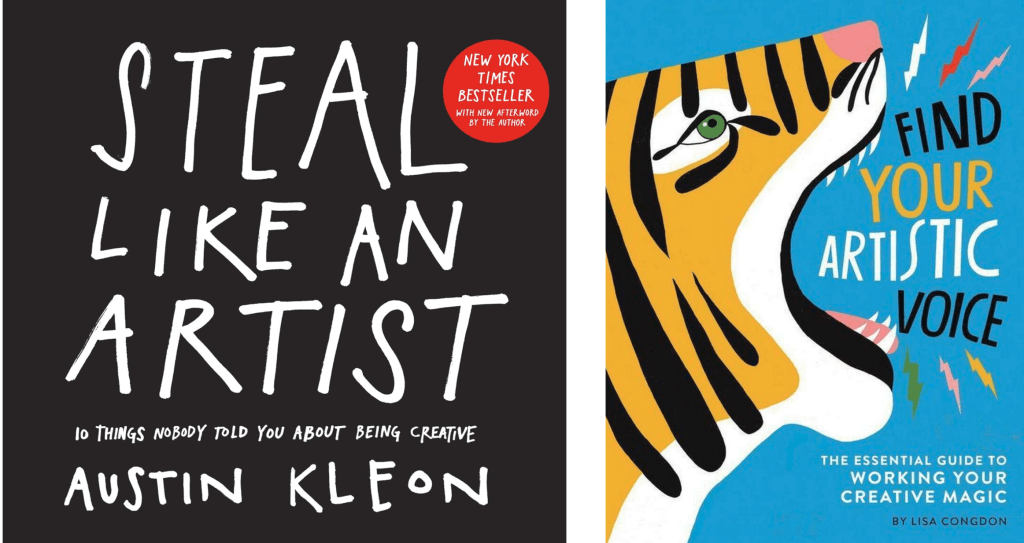
I have taken this to the extent, that I have developed workshops for the Royal Photographic Society on this topic. Two books that have influenced and guided my beliefs on the development of a creative voice are shown below (Kleon 2012), (Congdon 2019)
With regard to what constitutes Plagiarism, I remain somewhat conflicted. Several examples discussed within the collaboration project of Susan Meisels and others (Azoulay 2016), feel (in my opinion) to have crossed the line into plagiarism. I do not believe this will represent a popular belief, and perhaps I am too closely wedded to photographers such as Robert Frank to whom my early passions for photography were ignited. However, I believe that in taking samples of such work and using it to create other more simplisticly derived work (albeit original conceptual ideas), represents plagiarism.
REFERENCES:
Azoulay, A., 2016. Photography consists of collaboration: Susan Meiselas, Wendy Ewald, and Ariella Azoulay. Camera Obscura: Feminism, Culture, and Media Studies, 31(1), pp.187-201.
Congdon, L., 2019. Find Your Artistic Voice. Chronicle Books.
Kleon, A., 2022. Steal Like an Artist 10th Anniversary Gift Edition with a New Afterword by the Author: 10 Things Nobody Told You About Being Creative. Workman Publishing.
A surprisingly eventful week, that has accelerated my journey toward consolidating the direction of my research project. Monday was spent writing up the mirror/window reflection task. It appears that I responded in a formal essay style, rather than simply writing a piece of prose. However, I found the exercise useful in practicing responding to assignments.
Tuesday was taken up with a webinar on Critically and a presentation by the study support team ASK. The webinar on criticality was somewhat highjacked by frustrations from the student cohort on getting to grips with the various technologies, interfaces, and induction tasks of the course. I have marked as a todo, to research the full spectrum of meaning regarding criticality. The ASK presentation was quick but highlighted the study hub and its various support channels. Again note to self to visit this when time allows.
On the face of it, Wednesday was to be a background reading background day and a time to work through the second module. However, a meeting at my hairdresser sparked a conversation around poverty in which food banks were discussed. This idea then percolated once I got home and I began building the idea on the already under consideration project options of coastal depravation and town and gown inequality. The concept idea quickly grew in my head. The resulting output, a documentary study of the food bank and soup kitchen crisis that has engulfed the UK as a result of the spiraling cost of living and poor wage inflation at the bottom end of the wages spectrum. I made the decision to share this with Jesse Alexander and made contact. A meeting was set up for the Thursday morning.
During Wedneday afternoon and Thursday morning, I developed a short PowerPoint presentation covering the key elements of the project. Our discussion lasted 1.5 hours and Jesse made a number of highly valid points. Namely: The obvious challenges in access. The challenges I will face in order to gain trust. The locations chosen for the project, and the need to consider distance as a factor. Finally, he discussed the perspective of treating the sites as a feature within the landscape. Overall Jesse responded positively and despite my obvious concerns over the challenge of access, I feel a project idea is now taking shape and I can begin my initial research work.
Thursday saw our first meeting with Tim my tutor for this module. There were only three of us. The atmosphere was intimate and lively. Our backgrounds were shared and some progress was made with regard the critical evaluation of our portfolios with respect of this weeks project. It does feels as if much of the work for our weekly project will happen when we are working solo with group-based webinars acting more informally for questions and concerns.
Today being Friday, I have used the opportunity to complete my work on the second topic (Method & Meaning) and write up my CRJ. A productive week especially in terms of the consolidation of my research project focus and some really interesting ideas on project methodologies and ways to abrogate creative decision-making as a creative strategy. I must watch the various Alex Soth films to see this in action.
Task: To reflect on what challenged us within the topic, what was surprising, and what we felt we had learned. More specifically methods and methodologies we have historically used in our practice to convey meaning? Have any of these been unintentional? Finally, have any of the practitioners discussed, or our peers used strategies or methods that we might impose on ourselves in the future?
The most poignant learning outcome for myself from this week’s Methods & Meaning topic has been the idea that we can evaluate bodies of work to derive meaning in ways that are different from those applied to a single image. The three separate principles of Methods: Processes that apply to specific stages with the image creation journey, (for example,the use of film vs analogue). Concept: The creative intent of the photographer Methodologies: The systematic application of a series of methods to provide a distinct series of images that can be considered separately within an analytical discussion. These will be useful dimensions going forward when discussing my image output and evaluating their fit to the project objectives.
Having total control over every stage of the image-making process has been a key feature of my own photography from the beginning. This should come as no surprise to me as my go-to approach in work and life generally is to research comprehensively, plan well, and seek certainty through mastery of the process. Whilst this may work well for certain styles of landscape and architectural photography, this approach is less than ideal for street photography and documentary work. In truth I have been working hard on this aspect of my creative approach and to some extent have been able to ‘let go’ to certain aspects of the creative process. This has helped me create a more authentic street photography practice and more recently urban portraiture.
However, the degree to which some of the featured artists have applied methodologies to abdicate themselves from large parts of the creative decision process has both challenged and surprised me. The work of Chris Coekin in which he becomes a hitchhiker, randomly taking lifts and photographing his drivers feels extraordinary. The self-selection processes involved fall far outside of my comfort zone.
Conversely, the work of Gillian Wearing with subjects holding placards expressing how they feel offers some fascinating possibilities. Although the placard message concept is not new (it was featured in Richard Curtis’s film Love Actually), unlike the work of Chris Coekito I feel that Gillian Wearing’s methodology could perhaps play a potential role in my own work. I could imagine a situation whereby subjects who are featured in my environmental portraits, holding cards or objects that provide additional cues as to the individual’s role within the image.
The concept of psychogeography provided a fascinating perspective on limiting one’s geographic location during the image capture process. Whether by following a randomly prescribed route such as that described by Robert Mcfarlane or using demarcations and boundaries to define your subject matter as seen within the A to Z project of London by Mark Power, Psychogeography whether or not described explicitly as such has been used very effectively for example by Alex Soth in Sleeping by the Mississippi (see my post in the forum discussions for more detail).
FIGURE 1: Alex Soth. 2002. Joshua, Angola State Prison, Louisiana.
In truth, my own work has lacked distinct methodologies at the ‘body of work’ level. My practice has tended to focus on the power and aesthetics of the single image. My bodies of work, have consequently felt like a collection of single images, held together by a singularity of intent, but lacking cohesiveness as a collection. This week’s topic has provided ‘food for thought’ on how I might address this aspect of my work in the future. Both the consideration of methodologies and strategies at the ‘body of work level and the enforced abdication of creative control holds exciting possibilities. Over the coming weeks, I want to consider what these might be and share them with both the teaching staff and my peers.
TASK: To provide a personal perspective of the ‘mirror or window analogy’ and more generally its usefulness as an evaluative tool in photography. The 500-word essay should explore other metaphors that can provide insight into the drivers behind image-making as well as my own motivations within photography and its role within my aspirations as an image-maker and storyteller.
RESPONSE:
Reflecting on the Mirror Window Metaphor in Photography
Photography has been classified in many ways. Fine art, representational, landscape, portraiture, commercial. These labels, whilst useful, provide no clues as to the motivation and emotional connections between the photographer, subject, and viewer. The concept of an image being sited on a spectrum between a mirror, (an image created within the photographer’s imagination) and representational (an accurate account of the scene), was first described by John Szarkowski (Szarkowski, 1978). Szarkowski’s conceptualisation offered a new dimension by which photography could be examined. Despite its simplicity, the windows/mirror analogy provided a unique perspective through which one could explore the choices made by a photographer. Sarkowski however was not the first to describe the way in which images communicate both directly and indirectly. In his seminal book Camera Lucida (Barthes, 1981) explains that photographs contain both denoted (real) and connoted (implied) information.
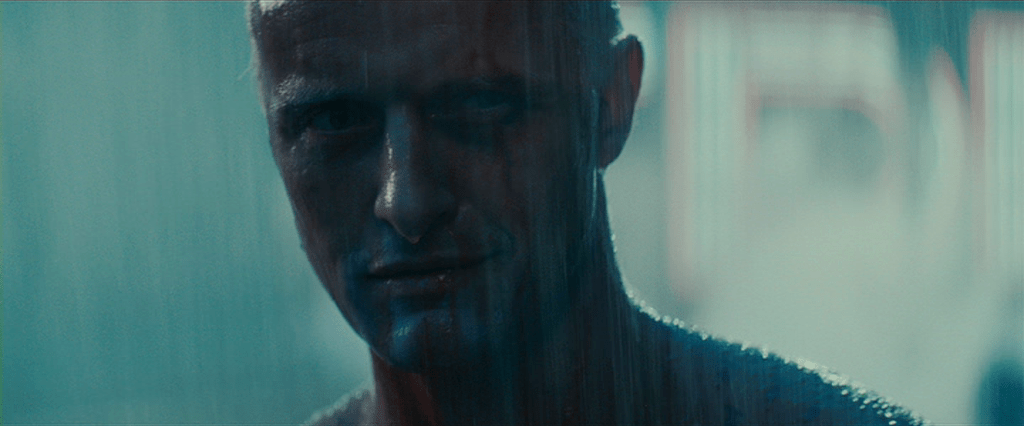
FIGURE 1: Ridley Scott. 1982. Blade Runner
My own journey as an image maker has been one of a gradual transition through the mirror/ window spectrum. My early work was heavily influenced by Cinematographers such as Roger Deakins and Christopher Nolan as well as Film Directors such as David Lean director of Lawrence of Arabia and Ridley Scott Director of the original Blade Runner (figure 1). My photographic inspiration from individuals included Michael Kenna, Don McCullin and Bill Brandt. My early landscape for example my work in Iceland, sits firmly within the fine art genre. It was dark, moody, and devoid of people.
After much soul searching, I concluded my landscape images were influenced by my desire to externalise the challenges of a bipolar and depressive maternal upbringing. Later in my creative journey and having left home and being happily married, I began to explore more cinematic style urban street scenes and modern architecture. Whilst these still contained a degree of self-reflection, they represented my attempts at more accurately representing the mood and drama within the urban environment without the overlay of implied dystopia.
Increasingly, I have been feeling creatively and intellectually restless. I want to focus directly on individuals, the issues that impact them, their emotions, their interactions, their lived experiences at work and play, their struggles and achievements. My sphere of photographic influence has also changed. The work of Mary-Ellen Mark, Bruce Davidson, Chris Killick and Robert Frank now all deeply resonate. Their intentional manipulation of both connoted and denoted visual codes provides their images with searing and deep-rooted messages that engage and challenge the viewer forcing them to confront the issues depicted.
I also recognise that the window/ mirror analogy is by no means the only useful metaphor. For example, one can view a body of documentary photography as acting as a microphone for a disadvantaged group. This is clearly seen in the photojournalism of W.Eugene Smith (Smith and Smith, 1975) who described the gradual poisoning of the local population in Minimata Japan. Without his images, commissioned by Life Magazine, we may never have heard their voices. Similarly, long-form documentary projects can see photography utilised in the same way and have the same influence as the mighty pen. When first published, The Americans by Robert Frank (Frank and Kerouac, 1978) was seen as a searing indictment of the failure of the American dream. The attempts to stifle its publication were similar to those normally associated with the censoring of a written report.
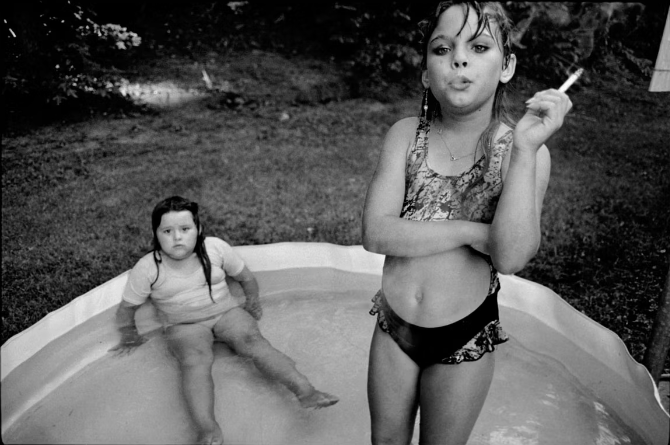
Sometimes photography can feel like a sociological x-ray machine, allowing us to see deeply into the soul of their subjects and vicariously experiencing their lives. The photography of Mary Ellen Mark (figure 2), Bruce Davidson, Don McCullin and Matt Black often exhibit these qualities. Other times this objectivity is purposely ignored. Instead, the photographer is looking to act as judge and jury. Through the selection of their subject matter, choice of the decisive moment, and the underlying rhetoric of their image, the photographer is unashamedly looking to influence the viewer. Whether as seen in the images of death and horror in the Vietnam War by Don McCullin (McCullin, 2020) or man’s destruction of the environment as seen from the air by Edward Burtynsky (Burtynsky et al., 2009) the photographer intends to shock the viewer.
FIGURE 2: Mary-Ellen Mark. 1990. Amanda and her cousin Amy
At a personal level, my initial motivations for photography were driven by a desire for concrete evidence of creative skill and mastery of technical expertise. However, whilst being able to achieve aesthetically pleasing work, increasingly I want to create work that is imbued with inherent meaning, reflects issues relating to the human condition and if possible, highlights unseen challenges in our society. I have been fortunate to be born at a time when social mobility was achievable with education and hard work. Whilst I have never looked back, I have also never looked down. I believe I have been somewhat immune to the challenges faced by so many in what is now a form of broken globalised capitalism. If only in a very small way, I am looking for my documentary photography to shed light on some of the injustices in today’s very unequal society.
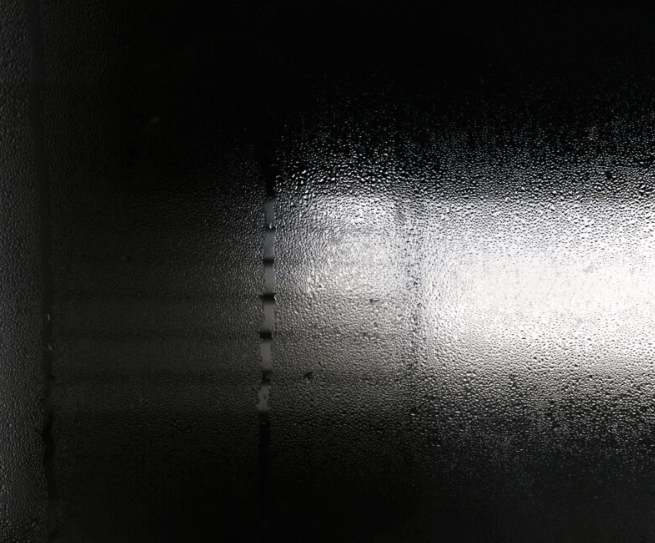
David Rosen : 5th Nov 2021 : Water Droplets on Glass : Spitalfields, London
Friday afternoon and it feels like it has been a long week. On the upside, the initial dense fog of confusion regarding the various interfaces, terminology, and online navigation structures has already begun to recede. I was already aware of the mirrors and window metaphor, but the increased focus demanded by the forum exercise and the writing exercise has created a deeper sense of its role and importance within photography. The impending essay (which I have now structured but have yet to write) has drawn out my own understanding of the concept and has been useful as another tool to help refine my self-reflection as a photographer.
I am constantly revisiting the question that has taken up so much of my attention in the weeks and months leading to the start of the course: What is going to be the main thrust of my research project and will this in turn drive the direction of my final project. Somehow I have seemed to have amassed no less than nine separate ideas. Does this mean I am inventive and creative or simply indecisive and lacking focus? Time will tell.
The first main event of the week was the introductory talk by Jesse who laid out the broad scope of our journey of the next two years and the various elements of the online infrastructure which we had all begun to attempt navigating. I had reviewed the slides before the lecture but all the same, it was useful to hear it being explained by our course leader.
Wednesday was spent creating a response for the forum where an image – A Portrait of Space by Lee Miller was shown. We were asked to provide our thoughts and reflections on the photograph, its meaning, and possible insights into our own relationship with photography. I tried to provide a very brief overview of my own journey over the past few decades and my increasing desire to create work of meaning. Seeing the responses of others reminded me that one can never predict how others might respond to a brief. There are always a myriad of possibilities of which we tend to only be aware of very few.
Wednesday evening was our first guest lecture from in this case Melanie Issaka. Exploiting the simplistic power of cyanotype self-portrait silhouettes mixed with colour images showing parts of her body Melanie demonstrated a powerful awareness of the sense of her own identity and how her appearance as a female creative from Ghana influenced her reaction to her and her work. Although the images were visually striking, I was interested in why she had not added context through descriptive text to explain her motivations in creating the work. Melanie explained that she preferred a strong sense of ambiguity to remain in her work. I wonder if I would want the same. I feel that my direction in wanting to create work of meaning within documentary photography will always feel more powerful when it is accompanied by descriptive text. I have yet to explore this further.
On Thursday I sat down in my local library with the intention of writing the 500-word essay on the mirror/window metaphor. To really find a meaningful position on the questions asked, I had to sit for some time (almost two hours), before the words and thoughts began to flow. Even then this was not even an early draft, more of a structure and set of signposts. However, the time invested was worth it. Although I am now running slightly late with the essay I have thoughts and a structure which I feel I can work with. The Mirror/window analogy is now firmly and comprehensively planted in my brain.
Thursday was also the first peer webinar where we got a chance to meet a number of our peers. In this case only three. The intimate group was in hindsight a better option as we were able to explore how we felt in more detail and with more candour than if we had been in a larger forum. I am certainly not alone in having yet to define my research and final projects. There were insecurities and apprehensions but also a sense of excitement and belief in the power of the journey.
Friday did not register as a day for Falmouth. A heavy commitment outside of the MA kept me away from my desk. One item of note. I finally committed to C41 development at home and have purchased the various chemicals and darkroom necessities to encourage more colour film shooting.
David Rosen : 21st Dec 2022 : Cornwall Coastline : Coastline Britain
It is the night before our first introductory webinar where we are to meet our cohort compatriots and our module and course leader Jesse Alexander. Our Fastnet cohort is gradually taking shape with a constant trickle of new sign-ups both for the dedicated Teams group as well as the newly created WhatsApp grouping.
It is perhaps not surprising at this stage that so many of us are feeling somewhat overwhelmed by the scale and breadth of the online interface we will be using over the coming months. It does seem however that the structure of the online portals has been carefully considered and there is a generous set of resources to help us grapple with navigation and course structure.
I have had a walk-through so far and this was perhaps helpful in gaining an initial perspective of the online environment. However, the first few days remained somewhat daunting as I tried to piece together how to navigate, book appointments, synch feeds across Outlook, and access the various guides that were buried within the Canvas universe.
I am somewhat lucky I suppose in having designed and created several websites within WordPress over the past few years. This has allowed me to progress relatively efficiently in creating a basic framework for the Critical Reflection Journal. This does not equate to understanding how this will be populated going forward but provides some basic comfort in having a visual framework at kickoff.
Tomorrow, our meeting with Jesse should start the process of personal connections for the cohort as well as acting as a forum for initial concerns to be raised and signposting where and how help can be accessed. My own challenges lay in building collaborative relationships whereby in the past I might have looked to solve my own problems and rely on myself for ideas and inspiration, I am keen to engage fully with the skills and talents of the group.



 The Photography of David Rosen